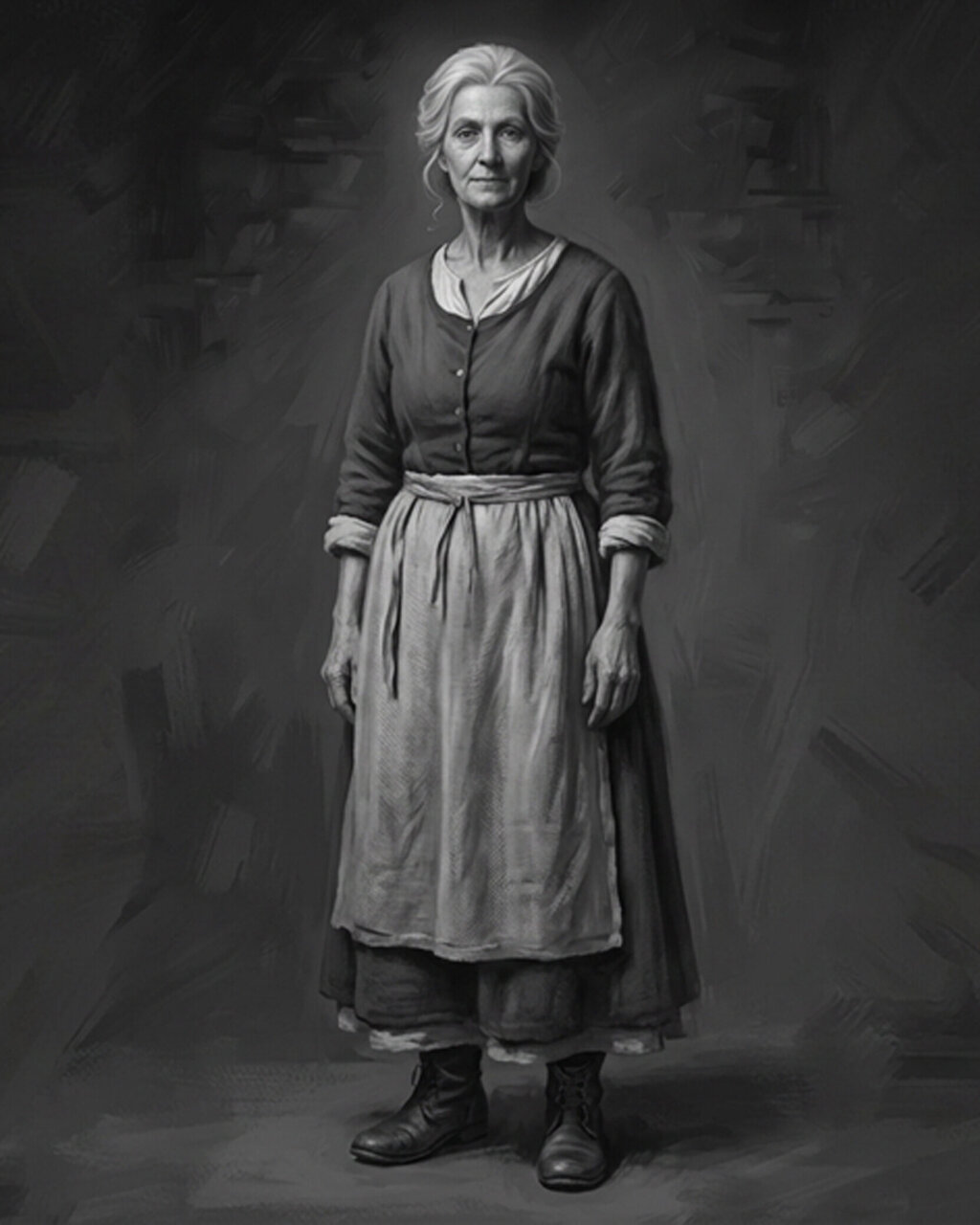


Somewhere in the turbulent years around 1580, Marycken Hanrick Michielen stands looking at what remains of her father's mill. Charred beams, ash, silence. The mill has burned down. So has her father. And her husband, who tried to save it. She no longer knows exactly who caused the fire that destroyed a large part of Bommel. A distant Spanish lord, an angry duke, troops who used the city as a plaything. It does not matter to her. The mill is gone. She is still here.
Marycken is neither a noblewoman nor a merchant's daughter. She is a miller, raised among the spindle and the sails, taught by her father how to grind grain, barley, groats and rye into flour. She has known the trade since childhood and she wants to mill. To support herself, to continue the work of her father and husband, to have something that is her own. In 1584, with the help of a scribe since she cannot write herself, she sends a letter to the town council. She requests permission for a new mill near the Gamersche gate.
The morning that the answer is waiting at the inn on the corner, Marycken puts on her yellow surcoat, her green sleeveless tunic over it and her white puffed cap loosely on her head. She chooses pattens over leather shoes, as she has a lot of walking to do today. With trembling hands she breaks the city seal. The clerk's handwriting is clear and brief. She reads that she is granted permission to relocate her mill outside the Gamerse gate, provided the city would suffer no negative consequences from it. The city will certainly notice nothing of it, thinks Marycken happily. She quickly tucks the letter into her leather bag under her tunic.
She runs to her brother Michiel. She falls into his arms. Together they walk to the barn where the remains of the burned mill have been kept. The post, the casing and the supporting beams are largely intact. The soot on the heavy oak beams actually makes the wood stronger, she explains to her brother. A protective layer. The cap and the sails can be reassembled by the millwright. There is enough wood in her brother's storage. There is still some of her late husband's estate. It can be done.
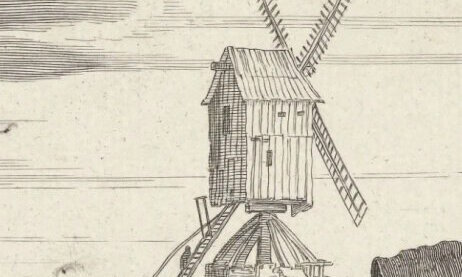
The mill that Marycken wants to build is a post mill, also called a wipmolen, staakmolen or kokermolen. It is a wooden construction, built around a heavy wooden post connected to the spindle, the sails and the millstones. The post is supported by eight quarter bars resting on stone foundations. At the back there is a large wheel, the tail, which is used to turn the mill: rotated so that the sail cross always faces into the wind. Via the tail, the miller climbs up a wooden staircase into the mill box, where the real work takes place.
At the Gamersche gate, mills are already under construction when Marycken seeks out the millwright. There is a good reason to mill here: the strongest and most frequent wind blows from the west, and the paved road makes it easy to transport the ground goods to the city. Mills side by side also means that millers can help each other with turning or with maintenance, when the large spindle needs to be greased with lard. Marycken knows many millers through her father. She is ready. She lets the millwright read her letter, but does not hand it to him. No one may touch the letter except her brother. It is the only proof she has.
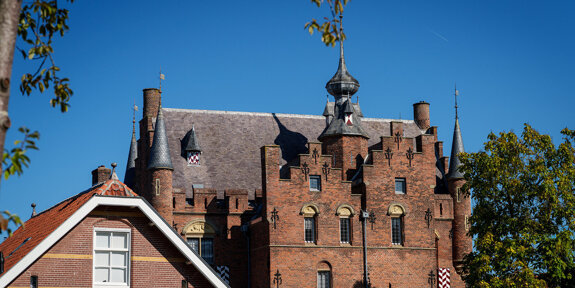
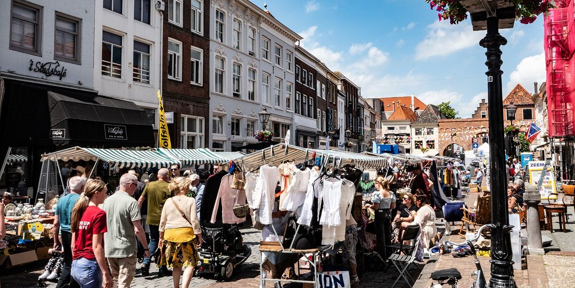
Walk along with Marycken Hanrick Michielsen, the miller's wife of Zaltbommel. In 1584 she requested permission to build a new mill near the Gamerschepoort, after her old mill had been lost due to war violence. Walk past medieval mill ramparts, the Gamerschepoort and monumental Hanseatic buildings.