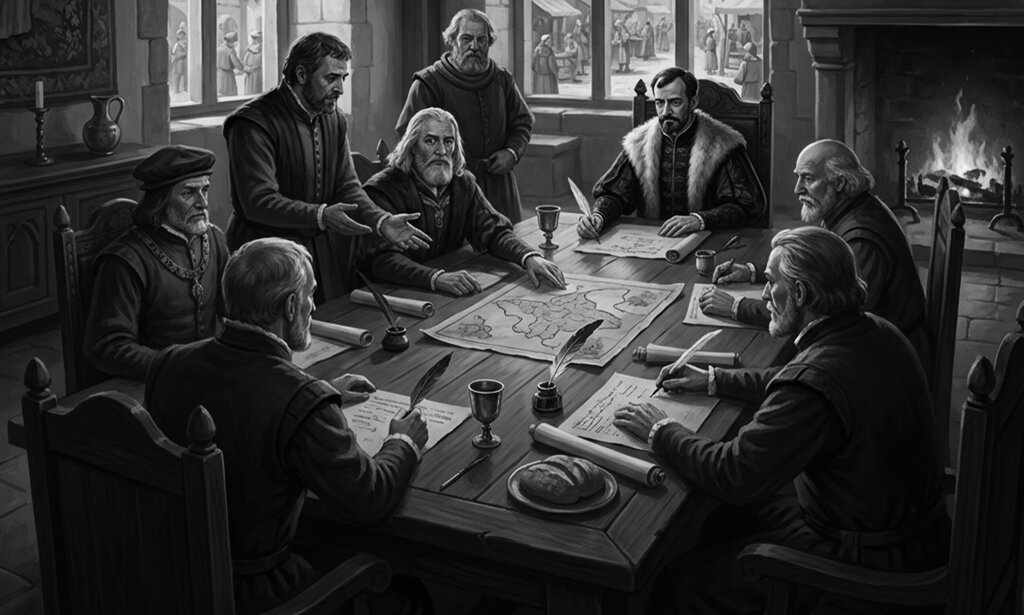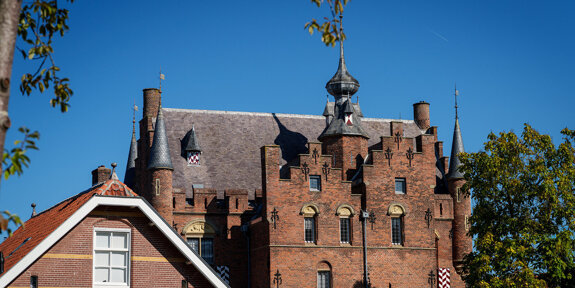
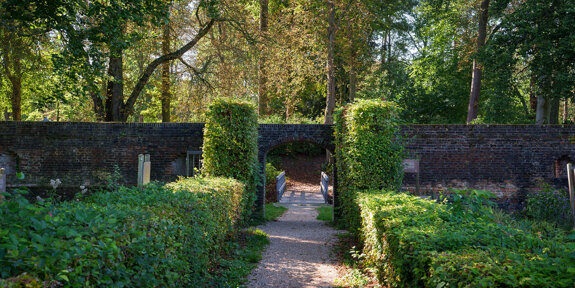
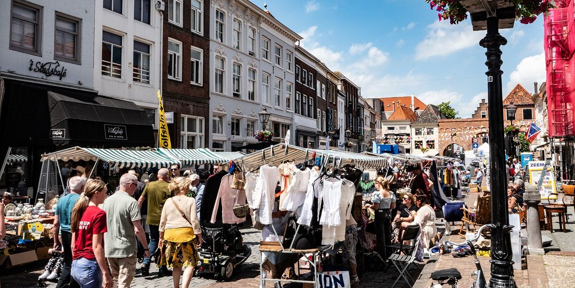


Everardus is more than an administrator. As a toll collector, he knows exactly which ships may pass freely and which Hanseatic cities do or do not pay contributions. He lives in a stone house, wears a cloak trimmed with beaver fur and golden rings on his fingers. And when he has a difficult decision to make, he seeks counsel from the recluse Aleid in the Sint-Maartenskerk.
In the Zaltbommel of the early fifteenth century, Everhardus van Balveren is no stranger. He comes from one of the most distinguished families in the city, with a fine coat of arms, a stone house and a name that has carried weight in the Bommelerwaard for generations. His grandfather Henrik was a squire in Drumpt near Tiel. His father Willem married Elisabeth van Haeften van Rhenoy. And Everhardus himself grew up with the awareness that a man of his birth has obligations, not only to his family, but to the city.
From 1394 until his death in 1436 he is alderman of Bommel, for more than forty years. This is no honorary position. Aldermen are the backbone of the city government, responsible for the administration of justice, official duties and the daily maintenance of everything that holds the city together: the streets, the quay walls, the city ramparts and the Waal itself, which must remain navigable for the ships that make Bommel great. Everhardus walks his rounds through the city, inspects, decides and takes care. Not from behind a desk, but with his own eyes.
Between 1423 and 1431, Everhardus holds the office of toll collector in addition to his position as alderman. A lucrative position, as Hanseatic ships constantly sail along the Waal carrying precious cargoes: salt, grain, timber, wool, wine and cloth from distant regions. Everhardus knows exactly who must pay toll and who does not. Hanseatic cities enjoy privileges, but those rights are constantly subject to negotiation and political wrangling.
For it is not all that simple. Bommel is a member of the Hanseatic League, but that membership is not a fixed given. Sometimes the city pays dues, sometimes not. In 1442, Bommel has itself represented by Nijmegen. In 1557, the city is not allowed to send a delegate to the assembly in Lübeck at all, because Cologne is obstructing. In 1591, Bommel is again a directly paying member. The Hanseatic League is a network of interests, and Everhardus stands right at the heart of it. He knows which ships deserve toll exemption, which requests he must submit to the Duke of Guelders and how to keep Bommel on the map, even when others make life difficult for the city.
Everhardus is a man who likes to present himself well. Not out of vanity, but out of a sense of duty: his family name obliges a certain appearance. His lucky tunic is dark red, darker than madder. Over it he wears a dark blue velvet doublet, with slits at the front and back so that the red colour shines through underneath. His black cloak is trimmed with beaver fur and decorated with embroidery. On his head he wears a felt hat with a dashing black feather, an heirloom from his grandfather. On his fingers gold rings: his wedding ring, his signet ring bearing the family coat of arms.
He is not sluggish, but well-nourished. As alderman and toll collector he walks a great deal, personally inspects the walls and quays and serves the city with his body as well as his mind. He probably lives in the stone house in the Bloemendaal, which has been in the family since his grandfather's time. The battlements are still there, though Bommel has had no need of them for a long time now that the city wall stands firm. But they do look distinguished, and that is reason enough to leave them in place.
On a cloudy afternoon in the fifteenth century, Everhardus van Balveren walks with heavy steps through the city. Bommel is not allowed to send a delegate to Lübeck. Cologne has blocked it. Nijmegen is already sending someone, and they consider that enough. How is he to explain this to the sheriff? How is he to explain it to himself, he who has read with his own eyes in the Hanze-Urkundenbuch that Saltzbommel is a full member, that it pays contributions, that it matters?
He walks along the city wall, establishes that no crack or imperfection is visible, and decides to consult the hermitess. Aleid has been living enclosed in the Sint-Maartenskerk since 1412, in a cell two metres wide and one and a half metres deep, with a barred window to the outside. Administrators, wealthy merchants and ordinary citizens seek her out for advice. Everardus puts money in the stone jug by her niche and places a piece of cheese on the dish beside it.
Aleid looks at him intently. "You are asking for directions to a place you already know," she says sharply. "In your heart you already know the answer." And then, after a long silence: "When we place it in the Divine Perspective of Centuries... it does not matter. The intention remains the same: openness, transparency and a spirit of trade. Documents do not matter."
Everardus leaves the church somewhat overwhelmed but also strangely relieved. The breeze that picks up feels refreshing. The Hanze has existed for centuries. Bommel has always been involved and always will be. In any case, every skipper calls at the city, if only for provisions. That feeling of divine happiness glowing within him as he walks through the familiar streets prompts him to a decision. In the Sint-Maartenskerk he will have a chapel built for the salvation of his entire family's souls. His son Johannes later carries out that wish. The Van Balveren chapel still stands today.
Walk along with Everhardus van Balveren, alderman and toll collector of Bommel in the fifteenth century. Discover how the city government worked during the Hanseatic period, what role distinguished families played and how trade, power and faith were closely intertwined. The walk leads past the most beautiful medieval sites of Zaltbommel: from the Waterpoort along the Waalkade, through narrow streets full of Hanseatic-era architecture, to the Sint Maartenskerk with the Van Balveren Chapel.