gtag('consent', 'update', {'ad_user_data': 'granted','ad_personalization': 'granted','ad_storage': 'granted','analytics_storage': 'granted' });
A A A
en
NL EN DE
Fotolux_Hanzestad_deel_1_19-09-2025_LR_07
Fotolux_Hanzestad_deel_1_19-09-2025_LR_05
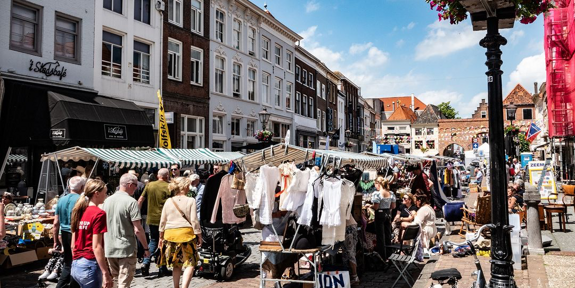
Bommelse Brocante
koopzondag-1771335579

Route Cycling route 3 Hanseatic cities

85 km
Cycle along the winding rivers of the Rivierengebied and discover three cities that once belonged to the powerful Hanseatic network: Zaltbommel, Tiel and Maasbommel. From city to city you feel the age-old spirit of trade, past medieval city gates, Gothic churches and places where water and commerce were once the lifeblood. You can start the route from all three cities and follow it easily via the cycling junction network.

Directions

1
Waterpoort - Starting Point Zaltbommel, Waterpoort
In the first half of the fourteenth century, a system of city defenses—consisting of a city wall and a moat—was constructed in Zaltbommel. Bommel formerly had five city gates: the Gamerschepoort, the Bosschepoort, the Oenselsepoort, the Steigerpoort, and the Waterpoort, the last of which is the only one still standing. The Waterpoort was restored in 1942–1943, acquiring its current appearance (without a layer of plaster). The reason the gate was preserved is not easily explained, but it may be linked to the fact that occupied houses had been built against its inner side.
2
Houses against the city wall Zaltbommel, Nonnenwal
Along the medieval city wall stand narrow, distinctive houses built literally against the ramparts. These structures are a remarkable example of land use in a medieval Hanseatic city, where every square meter within the safety of the city walls was precious.
3
Sint-Maartenskerk Zaltbommel, Kerkstraat
The imposing Gothic Sint-Maartenskerk dominates the skyline of Zaltbommel. The church was largely built during the 15th and 16th centuries, the heyday of the Hanseatic town. Its interior houses an organ described by Michael Praetorius—one of the most famous organs in the Netherlands.
4
City ramparts Zaltbommel, stadswallen
The well-preserved medieval city ramparts encircle the historic center of Zaltbommel. These fortifications protected the Hanseatic town for centuries and today offer walkers a magnificent view of the surrounding polders and the River Waal.
5
Former municipal pharmacy Zaltbommel, Markt
The monumental building on the Markt served as Zaltbommel’s municipal pharmacy for centuries. The building reflects the prosperity that Hanseatic trade brought to the city. The Markt was the beating heart of the Hanseatic town, where merchants from across Europe gathered to trade.
6
Inundation canal Tiel, Inundatiekanaal
The inundation canal near Tiel represents a remarkable piece of hydraulic engineering history. The canal was part of a defensive line that allowed the surrounding land to be flooded to keep enemies at bay. It serves as a peaceful resting point along the cycling route between Zaltbommel and Tiel.
7
Passewaaij Tiel, Passewaaij
Passewaaij is an archaeologically rich polder west of Tiel, featuring traces of settlement from the Roman era and the Middle Ages. Its location on the Waal River made the area an early hub for trade and transport, long before the Hanseatic League reached its heyday.
8
Sint-Maartenskerk Tiel, Plein
The Sint-Maartenskerk is Tiel's oldest and most striking monument. The church dates back to the 13th century and was expanded during the Hanseatic era. Like Zaltbommel, Tiel was an important Hanseatic city on the Waal River. The church dominates the city skyline and is visible from far across the river.
9
Gothic House Tiel, Plein 16
The Gothic House in Tiel is one of the best-preserved medieval stone houses in the Netherlands. Dating back to the 15th century, it stands as tangible evidence of the wealth that Hanseatic trade brought to Tiel. Its distinctive pointed arches and stepped gables tell the story of a thriving trading town.
10
Water Gate and former inner harbor Tiel, Waterstraat
During the Hanseatic era, Tiel’s former inner harbor and Water Gate formed the city's economic heart. Ships from across the Hanseatic region docked here to load and unload goods. Although the harbor has long since ceased to function, the site still evokes the atmosphere of a bustling medieval trading hub.
11
The Blue Lock Maasbommel, Sluisstraat
The Blauwe Sluis in Maasbommel is a historic hydraulic engineering structure that connects the Meuse River with the surrounding polders. Dating back to the 19th century, the lock is a fine example of Dutch hydraulic engineering. Maasbommel marks the eastern terminus of the Hanseatic Route.
12
Hanseatic League & Basket Weaving Mural Maasbommel, Dorpsstraat
A striking mural in Maasbommel depicts the town's Hanseatic history and the traditional basket weaving for which it was once known. Basket weaving was a major local industry; the woven baskets were traded across Europe via Hanseatic routes.
13
Castle ruins Het Hof Maasbommel, Hofstraat
The "Het Hof" castle ruins in Maasbommel are all that remain of a medieval castle that once dominated the region. The castle played a role in the power struggles over the Meuse trade routes, which were vital to Hanseatic trade. The ruins stand as a silent witness to a turbulent past.
14
St. Lambertus Church Maasbommel, Kerkstraat 1
The Church of Saint Lambert is the current parish church of Maasbommel, built in the 19th century on the site of a much older church. Saint Lambert was the patron saint of the community that lived and traded along the Meuse here as early as the Early Middle Ages.
15
Former Sint Lambertuskerk Maasbommel, Kerkstraat
The former Sint Lambertuskerk marks the end of the Hanseatic Route in Maasbommel. The medieval church building serves as a reminder of the time when Maasbommel was a thriving community on the Meuse, connected to the Hanseatic cities via busy waterways. It is a fitting conclusion to a journey through 700 years of Hanseatic history.
Fietsroute Hanzesteden